
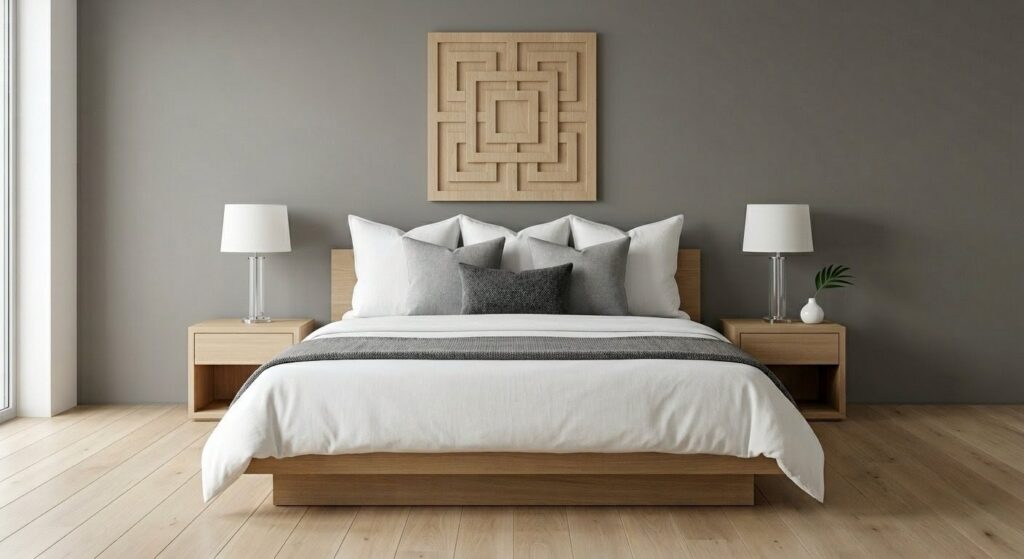
In the geography of a home, the primary bedroom is the destination. At The Defined Dwelling, we treat this space with primary bedroom staging logic, which prioritizes symmetry and “Visual Quiet.” A bedroom should not be a collection of furniture; it should be a cohesive environment that signals immediate decompression. By stripping away personal clutter and focusing on the bed as a structural anchor, we allow the buyer to visualize the room as a true sanctuary.
The Power of Symmetry
In bedroom logic, symmetry equals stability.
- The Rule: If possible the bed should be centered on the primary wall, flanked by two identical nightstands and two identical lamps.
- The Logic: This creates a formal “frame” that grounds the room. Even in a small room, symmetry provides the psychological “balance” a buyer needs to feel a sense of order. When the nightstands match the scale of the bed in height, the room feels architecturally resolved.
Textural Layers vs. Color
It is best to avoid bold patterns or “accent walls.” Instead, use a monochromatic stack of textures to create depth.
- The Bedding: We start with a crisp, white base and layer a duvet or throw at the foot of the bed.
- The Logic: This reflects the neutral rug staging logic used in the living areas, creating a “thread of continuity” throughout the home. We use clean and tactile fabrics to provide luxury without introducing visual noise. There is no need to break the bank here – you can find plenty of inexpensive options online to create this look. Check out my SHOP page for some curated lists to help you fill in any gaps you might have.
Underfoot: The Bedroom Rug Scale
The “Logic” of the bedroom is grounded by the rug. As a rule of thumb, the rug must be large enough to act as a frame for the furniture, not just a soft spot for your feet.
- The Scale: For a King-sized bed, we recommend a 9’x12′ rug. For a Queen, an 8’x10′ is the standard.
- The Placement: The rug should be pulled approximately two-thirds of the way under the bed, stopping just before the front legs of your nightstands. This leaves a consistent border visible around the perimeter, which defines the sleeping zone without swallowing the room’s architecture.
Curating the Inventory: Furniture and Surfaces
In a staged bedroom, every piece of furniture must justify its existence. If a chair or a bench doesn’t serve the [Sanctuary Logic], it must be removed. Once the furniture is edited, we turn to the surfaces.
- The Surface Rule: Clear everything personal. All surfaces—nightstands, dressers, and vanities—should be stripped back to a single “Statement” item. A clean, architectural stack of two linen-bound books or a small ceramic vase is intentional; a collection of loose change and charging cables is a distraction.
- The Visual Quiet: By clearing the visual field, you allow the buyer to focus on the room’s volume and light rather than your daily habits.
Living in the Logic: The “Bin” System
The greatest challenge in staging is living in the home while it’s on the market. To maintain a “Defined” look, you must hide the utilitarian realities of life—mouth guards, C-pap machines, and daily medications.
- The Solution: Invest in a set of high-quality, uniform bins. Every morning, the items you use daily should be “scooped” into these bins and tucked away in a designated cabinet or on a closet shelf.
- The impression: When a buyer looks at a nightstand, they should see a curated surface, not the machinery of your nighttime routine.
The Closet Edit: Thinning the Volume
A buyer isn’t just buying a room; they are buying storage. If your closet is bursting with four seasons of clothing, the room feels “small” and the home feels “inadequate.”
- The Edit: I advise sellers to pack away at least one full season of clothing and all bulky luggage. You have to pack anyway, so just get a head start!
- The Impression: By thinning the closet by 30-50%, you give the impression of abundance. It suggests that the home has plenty of space for the buyer’s life because your own life fits so effortlessly within it.
*Commissions may be earned