The most common mistake in home presentation isn’t the furniture—it’s the rug. I’ll be honest with you, using no rug is better than the wrong rug. A rug that is too small acts as a “visual island,” making the entire room feel disconnected and fragmented. At The Defined Dwelling, we view the rug as the Neutral Anchor. It is the boundary line that defines the “living zone” and provides a tactile foundation for the rest of the entryway staging logic we’ve discussed. It can also define purpose within a large open space.
The Scale Rule: All Legs on Deck
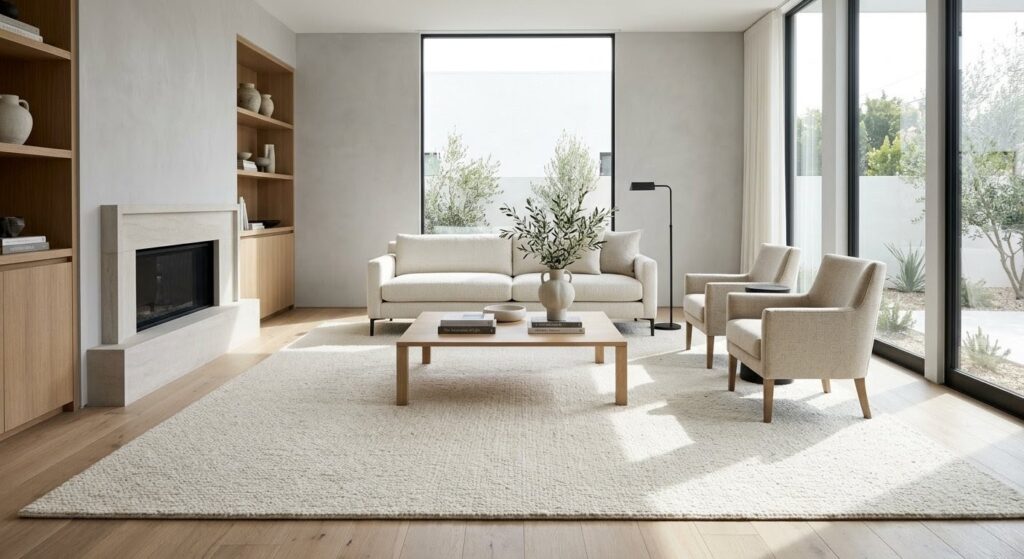
In professional staging, scale is the priority. A rug should be large enough that at least the front legs of all major furniture pieces sit comfortably on it. This creates a “Unified Field” that visually expands the square footage of the room. When a rug is too small, the furniture looks like it is “falling off” the space, which creates a subconscious sense of instability for a visitor.
Texture Over Pattern: The Visual Quiet
We prioritize high-texture, low-pattern rugs. Neutral rug staging logic dictates that the floor should remain “quiet.” Busy patterns draw the eye downward, away from the architectural highlights of the home. Instead, we look for:
- Wool Blends: For a matte, high-end look.
- Jute and Sisal: For an organic, architectural texture.
- High-Low Piles: For subtle, monochromatic depth without the “noise” of a print.
Color Temperature of the Floor
Just as we use architectural lighting logic to unify a home, we use the “Floor Anchor” to manage the color temperature of the room. If a home has orange-toned oak floors, a cool-grey rug will clash. We look for “greige” or “oatmeal” tones that bridge the gap between warm wood and cool walls, creating a cohesive, inviting palette that feels intentional.
Acoustic Architecture: The Sound of a Luxury Home
Beyond the visual boundary, the Neutral Anchor serves a critical, often overlooked function: Acoustic Management. High-end modern homes often feature hard, reflective surfaces—polished concrete, large-format porcelain, or white oak flooring. Without a high-quality rug to absorb sound, these spaces can feel “hollow” or clinical.
We can use the rug to “tune” the room’s acoustics. A thick, natural-fiber rug softens the reverb, making a large, open-concept space feel quiet, grounded, and expensive. When a buyer walks through a home and their footsteps are muffled by a dense wool pile, it creates a subconscious sense of peace and privacy. We aren’t just staging for the eyes; we are staging for the ear.
Agent’s Insight: The Value of the Visual Cleanse
In modern, open-concept floor plans, a lack of physical walls can often lead to “spatial confusion.” When a home is vacant, large expanses of hardwood or stone can feel vast and aimless, making it difficult for a buyer to visualize how the home actually functions. At The Defined Dwelling, we use the rug as a tool of spatial demarcation. By placing a well-scaled rug, we are essentially building “invisible walls” that define the specific purpose of a zone—transforming a cold, open void into a distinct, intentional living area. This allows the buyer to stop questioning the layout and instead begin experiencing the flow of the home. A clean, well-scaled neutral rug doesn’t just “decorate” a room; it provides a “Visual Cleanse” that allows the buyer to imagine their own life unfolding in the space. It signals that the home has been treated with care and intentionality. One of the most frequent questions I receive is whether a bold pattern might make a room “pop.” The “Defined” answer is always no. A bold rug is a commitment that a buyer may not be ready to make. A high-quality, textured neutral rug, however, is an invitation. It allows the architecture to remain the star of the show while providing the warmth and “finish” that a high-end property requires.
*Commissions may be earned