
In a high-end interior, greenery is not an accessory; it is a living sculpture. At The Defined Dwelling, we move away from small, scattered pots that create “visual clutter” and instead focus on architectural plant staging logic. We use greenery to provide height in empty corners, to soften the hard lines of a modern sofa staging scale, and to bring a sense of life to a minimalist art staging logic gallery. The goal is to choose specimens that feel like they were grown for the room’s specific proportions.
The Rule of Singular Impact
The most common staging mistake is “The Greenhouse Effect”—placing too many small plants in a single room. This breaks the neutral anchor of the space and distracts the eye. See if you can find a temporary home for any of your plants that don’t have a really defined and intentional purpose during the active phase of selling your home.
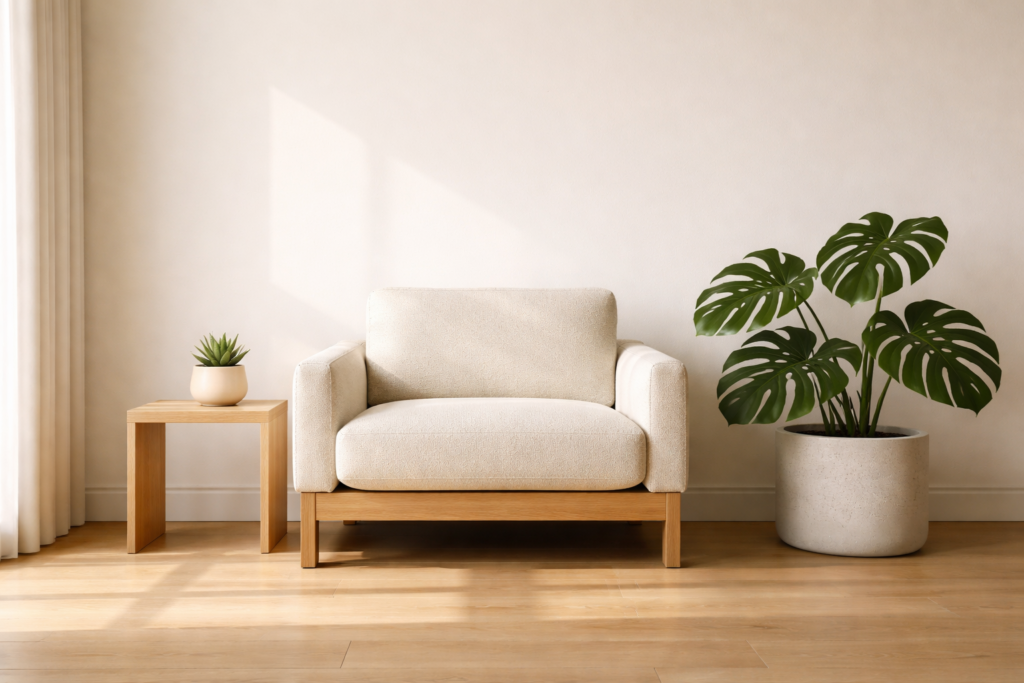
- The Look: One large, high-quality tree in a heavy, matte-ceramic or stone planter creates a “Defined” corner that feels intentional and expensive.
- The Logic: We prioritize one “Statement Tree” over five small pots. A single, tall Mediterranean Olive or a structural Dracaena provides a vertical line that draws the eye toward the ceiling, emphasizing the home’s volume.
The Organic Bridge: Humanizing the Monolith
While our Oatmeal palette and neutral rug staging logic create architectural purity, a space can occasionally feel too “resolved”—almost clinical. At The Defined Dwelling, we use greenery as the “Organic Bridge.” A living element introduces a rhythmic imperfection that makes a perfectly staged house feel like a home. It suggests vitality and longevity; when a buyer sees a thriving, well-placed tree, they are subconsciously perceiving a space that is “breathable” and lived-in.
Chromatic Contrast: The Strategic Pop of Green
In a world of monochromatic neutrals, green is the only “color” we treat as a neutral. Because it is found in nature, the human eye accepts deep forest greens and silvery sages as part of the background, yet they provide a vital chromatic break.
- The Logic: In a room of creams, oaks, and greiges, the vibrant pigment of a leaf makes the neutrals look cleaner and the whites look brighter.
- The Visual Pulse: This “pop” prevents the eye from becoming “snow-blind” to the room’s architecture, highlighting the precision of the minimalist art staging logic on the walls.
Negative Space and Leaf Silhouette
In architectural plant staging logic, the shape of the leaf is as important as the color.
- The Silhouette: We favor “airy” silhouettes—like the thin, silvery leaves of an Olive tree or the delicate fans of a Lady Palm. For a bolder statement, we look to the Monstera Deliciosa. Its dark, waxy leaves and architectural ‘fenestrations’ (natural holes) provide a high-contrast silhouette that grounds a corner and adds a sense of established luxury.
- The Logic: These plants allow light from our architectural lighting logic to pass through them, creating beautiful shadows on our Stone Grey walls without blocking the room’s “Architectural Breath.”
- The Placement: We place greenery where a room feels “thin”—usually in the corner opposite a large piece of furniture—to balance the room’s visual weight.
Secondary Life-Points: Fruit and Flora
Architectural greenery isn’t limited to large-scale trees. We use “Secondary Life-Points” to define smaller zones:
- The Kitchen Edit: On a kitchen island or a mid-century console, a low-profile ceramic bowl filled with uniform green fruit—like limes or pears—serves a dual purpose. It reinforces the organic green palette while signaling freshness and health.
- The Spa Logic: In bathrooms, we pivot to the Orchid. A single-stem white orchid is a staging standard because of its structural, “sculptural” silhouette. It creates a spa-like atmosphere that feels elite and hygienic, providing a soft contrast to the hard surfaces of stone and tile.
Strategic Restraint
The goal here is not to fill every corner. By strategically placing greenery only where it is needed to “bridge” a gap or “breathe” life into a neutral zone and add a pop of interest to the photos, we maintain the home’s architectural integrity. This is the difference between “decorating” a room and “Defining” its potential.